
Nightmares, Prayers and St. Michael
Pope Leo XIII, a vision of Hell and a powerful prayer.

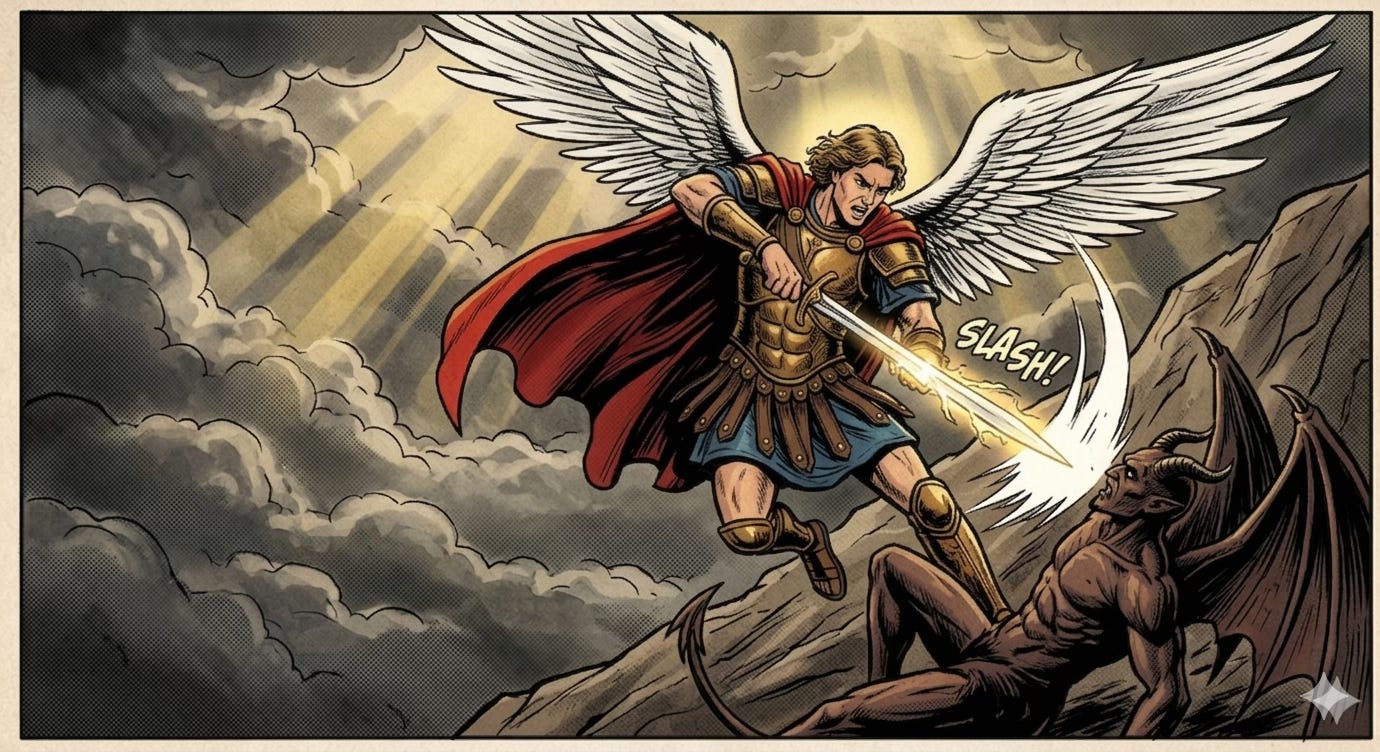
Think about the last time you experienced a nightmare. Sounds. Feel. Tension.
Or maybe you barely remember it at all and only recall waking up with a bad memory of a dream.
Now, instead of just thinking about your nightmare. Imagine taking what you heard or saw and writing one of the most impactful prayers in the last 120 years that’s been recited by billions.
That’s the foundation of the Prayer of St. Michael. That and a vision of hell.
"Saint Michael the Archangel, defend us in battle.
Be our protection against the wickedness and snares of the devil;
May God rebuke him, we humbly pray;
And do thou, O Prince of the Heavenly Host, by the power of God,
thrust into hell Satan and all evil spirits who wander through the world
for the ruin of souls. Amen."
The Prayer of Saint Michael begins with the man who wrote it: Pope Leo XIII.
Pope Leo XIII would hold many “modern firsts” as Pope. He would be the first pope to have his voice recorded, the first to be recorded on a motion picture camera. He holds the fourth-longest reign for a pope (1878 - 1903) and was involved in the First Vatican Council in 1869.
Leo XIII would have a kind interaction with Thérèse of Lisieux in 1887 and met with French science fiction writer Jules Verne in 1884. He required the study of Thomas Aquinas through ‘Thomism,’ opened the Vatican Secret Archives to researchers and refunded the Vatican Observatory and established the Catholic University of America.
He would be nicknamed the “Rosary Pope” for his devotion to Mary and aimed to make a Mediatrix or mediator to Jesus. His other nickname is the "Pope of Labor" for his 1891 encyclical Rerum Novarum that defended workers' rights on things like fair wages, private property, and labor unions.
Despite all these temporal successes, Leo XIII may give his greatest contribution to the Church with his reaction to a terrifying vision in 1884.
The Pope’s inspiration for a prayer to St. Michael is credited to October 13, 1884. After mass, the Pope allegedly collapsed for several moments until he arose, pushed away priest and cardinals helping him and immediately wrote the prayer.
Leo XVIII would claim seeing a disturbing vision: demons from Hell, Saint Michael fighting them and a conversation between God and Satan where the devil claimed he could destroy the Church in next century. God reportedly gave this power to Satan over the next 100 years (the 20th century).
Saint Michael’s prayer is perhaps the more militant of Catholic prayers. It’s a call for protection but a direct mediation on Saint Michael, the militant of all angels in traditional religious teachings. While the prayer stopped being required at mass in the 1960s, Pope John Paul II asked Catholics to begin to use it again decades later.
In Regina Coeli, Pope John Paul II said, “Although the prayer is no longer recited at the end of Mass, I ask every one not to forget it and to recite it to obtain help in the battle against the forces of darkness and against the spirit of the world.”
Pope Leo XIV said he was directly inspired by Leo XIII. Although Leo XIV was inspired by Leo XIII and his views on workers rights, maybe it’s a promising sign that he chose the name of his predecessor who penned one of the most impactful prayers of the modern Catholic Church.
I like this prayer, particularly because it is very militant. Saint Michael is also considered a warrior angel in the eastern church. Although Saint Demetrius would be a close rival, and was associated particularly with the city of Thessalonica, and its deliverance from enemies more than once. Also, the two Theodore‘s. One being Saint Theodore, the recruit, and the other Saint Theodore the commander.
Thank you for this. I might just memorize the prayer!